The Conditional Logic and Quantifier Guide
Conditional logic still shows up in Inference, Principle, and Sufficient Assumption questions. This illustrated guide covers it in eleven parts.
By Germaine Washington ·
With Logic Games gone, formal logic matters less on the LSAT than it once did, and prep has understandably shifted with the test. However, that has also made it easier to underprepare for the question types where conditional logic still shows up: Inference, Principle, Sufficient Assumption, Parallel Reasoning, and others.
That creates an opportunity for students to gain a competitive advantage by familiarizing themselves with the test’s logic. Learn the rules, practice the translations, and you’ll find that improvement here is much more consistent than in many other areas of the LSAT. What follows is a quick reference guide to help you with that practice.
Part 1: Conditional relationships
Identify the sufficient and necessary conditions first. Then translate the relationship into a diagram or plain English.
Conditional and "all" statements
A conditional is a relationship in which one condition guarantees another. Write it
A guarantees B and read it as "if A, then B."
- A is sufficient: if A occurs, B follows.
- B is necessary: B is required for A.
- One direction only: A guarantees B, but B does not guarantee A.
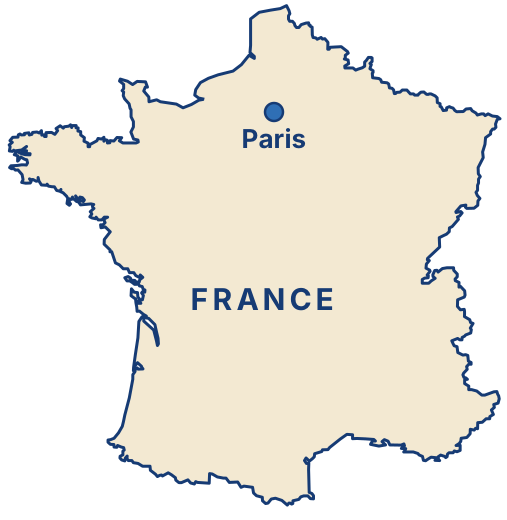
Paris guarantees FranceThe contrapositive
For A guarantees B, the absence of B guarantees the absence of A. Two steps get you
there:
- Reverse — place the conditions in the opposite order.
- Negate — negate both conditions.
So A guarantees B becomes not B guarantees not A. The contrapositive has
the same meaning as the original conditional relationship.
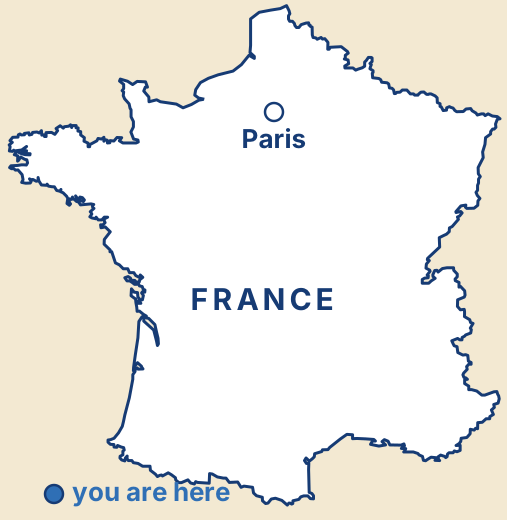
not France guarantees not ParisPart 2: Indicators
Which condition does the indicator introduce?
Sufficient condition indicators
The arrow points away from the term being modified by the indicator.
Invariably / Inevitably / Ensures / Guarantees / Is
A guarantees BA valid ticket ensures entry.
Ticket guarantees EntryWill enable [someone] to / Allows
Condition guarantees OutcomeA key allows you to open the door.
Key guarantees Can Open DoorAll / Every / Any / When(ever) / Provided that / As long as
A guarantees BAny valid contract is binding.
Valid Contract guarantees Binding
Necessary condition indicators
The arrow points toward the subject of the indicator.
Can be explained only by
Phenomenon guarantees CauseA crash can be explained only by pilot error.
Crash Happened guarantees Pilot ErrorOnly / Only if / Only by / Only through
A guarantees BThe car starts only if there is gas.
Starts guarantees GasRequires / Must / Essential / Presupposes / Precondition
A guarantees BEvolution requires time.
Evolution guarantees TimeDepends on / Is contingent on / Is governed by
A guarantees BSurvival depends on adaptation.
Survive guarantees AdaptImpossible without / In the absence of / But for
Result guarantees RequirementVictory is impossible without sacrifice.
Victory guarantees Sacrifice
Part 3: Quantifiers
How much of one group overlaps another?
-
All
12 of 12
-
Most
9 of 12, over half
-
Some
2 of 12, at least one
-
None
0 of 12
-
Few
3 of 12, under half
Filled circles show how many members also belong to the second group.
-
"Most" (more than 50%). More than half of the members of one group are
in another group.
"Most basketball players are tall" is
Basketball Players most are Tall Peopleand tells you that over half of basketball players are tall. -
"Some" (at least one). At least one member of a group is in another
group.
"Some basketball players are short" is
Basketball Players some are Short Peopleand tells you at least one basketball player is short. - Many is a vague quantity. Treat it as some.
-
Few establishes two relationships at once. "Few politicians are
independent" gives you both
Politician some are IndependentandPolitician most are not Independent.
Hierarchy (all > most > some). A stronger quantifier can also imply a weaker one. For example, "All dogs are mammals" also tells you that some dogs are mammals.
Quantifier indicators
Some / Many / Several / Often / At least one
SomeMany birds migrate.
Birds some are MigrateMost / Majority / Usually / Typically / Almost all
MostMost businesses fail.
Businesses most are FailFew / Rarely / Seldom
Most of A are not BFew people live to 100.
People most are not Live to 100Not all / Not every
A some are not BNot all that glitters is gold.
Glitters some are not GoldNo / None
A guarantees not BNo square is a circle.
Square guarantees not Circle
Part 4: Valid conclusions
The rule: an "all" conditional carries forward whatever quantifier reaches it.
All-to-all chain
All poodles are dogs, and all dogs are mammals. Every poodle therefore belongs to the larger group of mammals.
Poodle guarantees DogPremiseDog guarantees MammalPremisePoodle guarantees MammalConclusion
Most followed by all
Over 50% of US citizens live in the continental U.S., and everyone in the continental U.S. lives in North America. So over 50% of US citizens live in North America.
US Citizens most are Continental USPremiseContinental US guarantees North AmericaPremiseUS Citizens most are North AmericaConclusion
Some-to-all chain
Some sea creatures are predators. Since every predator consumes other animals, those same sea creatures must consume other animals.
Sea Creatures some are PredatorsPremisePredators guarantees Consume Other AnimalsPremiseSea Creatures some are Consume Other AnimalsConclusion
Two majorities within one group
Eight of the twelve students study biology and seven study Spanish: fifteen enrollments among twelve students. Since each group is more than half the class, at least one student must study both. In this case, three do.
Students most are Study BiologyPremiseStudents most are Study SpanishPremiseStudy Biology some are Study SpanishConclusion
No valid conclusion
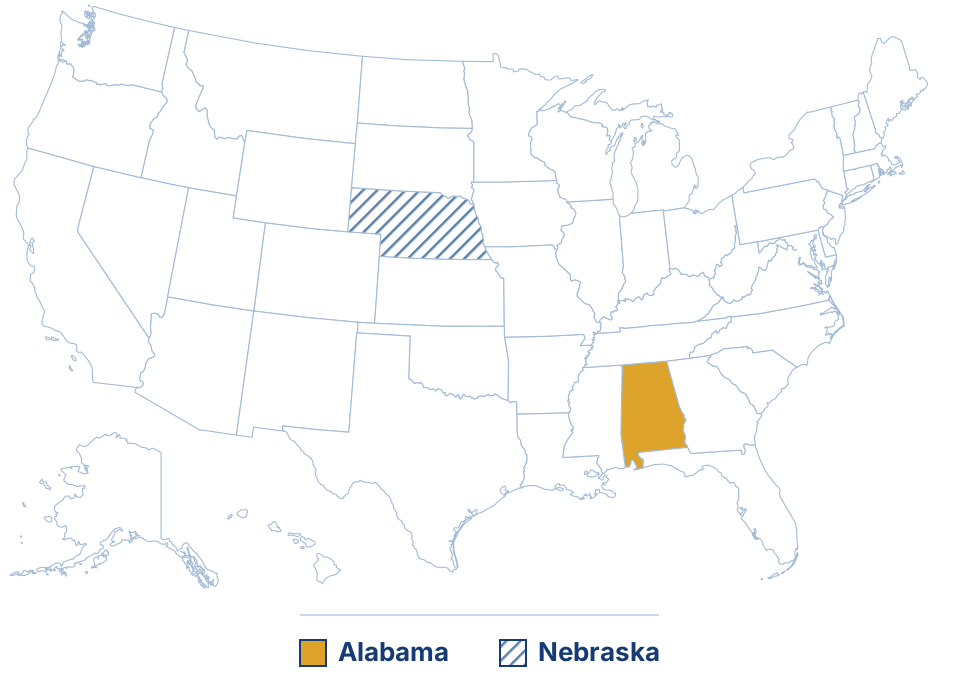
Be very careful in dealing with a mixture of "all" and "some" conditionals, as you can see in this example. Even though every single person born in Alabama may be American, a strong relationship, and some Americans are born in Nebraska, it is clearly the case that no one (not some) born in Alabama is born in Nebraska. And so you can never confidently conclude anything from an "all" into "some" relationship.
Born in Alabama guarantees AmericansPremiseAmericans some are Born in NebraskaPremiseBorn in Alabama some are Born in NebraskaDoes not follow
Part 5: Compound statements
And / Both
A + BHe is rich and famous.
Rich + FamousOr / Either … or
A or BWe can walk or drive.
Walk or DriveNeither … nor
not A + not BNeither rain nor snow stops the mail.
not Rain + not Snow
"And" and "or" inside a conditional
- "And" in the necessary condition —
A guarantees (B and C)Splits into two relationships:
A guarantees BandA guarantees C. - "And" in the sufficient condition —
(A and B) guarantees CBoth sufficient conditions are required together. Do not split.
- "Or" in the necessary condition —
A guarantees (B or C)At least one of the necessary conditions is required. Do not split.
- "Or" in the sufficient condition —
(A or B) guarantees CSplits into two relationships:
A guarantees CandB guarantees C.
Minimums, maximums, and nested conditions
- At least one (minimum of one)
"You must choose A or B." Refuse one and you must take the other.
not A guarantees Bnot B guarantees A - Not both (maximum of one)
"You cannot choose both A and B." Take one and the other is out.
A guarantees not BB guarantees not A - Nested conditional
"If A happens, then if B happens, C happens." Read it as an "and" sufficient condition.
(A and B) guarantees C
Part 6: Negation
Negating a statement means identifying its exact logical opposite.
Negating "and" and "or": De Morgan's laws
When you take the contrapositive of a statement containing "and" or "or," change "and" to "or" and "or" to "and."
Original
A guarantees (B and C)
If you get promoted, you get a raise and an office.
Contrapositive
(not B or not C) guarantees not A
If you don't get a raise or you don't get an office, you aren't promoted.
Original
(A or B) guarantees C
If it rains or snows, we stay inside.
Contrapositive
not C guarantees (not A and not B)
If we don't stay inside, it isn't raining and it isn't snowing.
Negating a quantifier
- All
"All A are B"
A guarantees Bnegates to "some A are not B"A some are not B. - Most
"Most A are B" (over 50%) negates to "half or less" (0–50%).
- Some
"Some A are B" (at least one) negates to "none"
A guarantees not B.
Part 7: Exclusion, and the "unless" family
To translate a statement using "unless," identify the idea that follows "unless," negate that idea, and make the negated form sufficient. The other part of the sentence goes on the necessary side of the arrow.
- Start with the sentence [B] unless [A] — "I will go to the movie unless it rains."
- Negate [A] and make it sufficient "If it does not rain, then I will go to the movie."
-
Convert to a diagram
not Rains guarantees Go
Use the same method for "except", "without", "until", and "or else".
Unless / Except / Without / Until / Or else
not A guarantees BThe alarm rings unless the code is entered.
not Code guarantees AlarmNo / None / Never / Fail to be
A guarantees not BNo mammal breathes water.
Mammal guarantees not Breathes WaterNo [X] is both [Y] and [Z]
X guarantees not (Y + Z)No number is both even and odd.
Number guarantees not (Even + Odd)Unless [A] or [B]
not Trigger guarantees (A or B)The deal fails unless you pay cash or trade goods.
Deal Succeeds guarantees (Pay or Trade)Not [A], let alone [B]
not A + not BHe is not a mayor, let alone a president.
not Mayor + not PresidentNo one who is not [A] is [B]
B guarantees ANo one who is not a lawyer is a judge.
Judge guarantees Lawyer
Part 8: Two-way and hypothetical statements
Biconditionals
A biconditional is a two-way conditional relationship in which both A guarantees B
and B guarantees A are true. Having either A or B guarantees the other.
If and only if / Then, and only then / All and only / When and only when
A if and only if BA number is even if and only if it is divisible by two.
Even if and only if Divisible by 2Equivalent to / Is the same as saying / Exactly when
A if and only if BHaving exactly 100 cents is the same as having one dollar.
100 Cents if and only if One Dollar
Hypotheticals and complex statements
Otherwise
not A guarantees BWear a helmet, otherwise you risk injury.
not Helmet guarantees Risk InjuryHad [A] occurred, [B] would have occurred
A guarantees BHad the levee held, the city would have remained dry.
Levee Held guarantees Dry[B] would not have occurred had [A] not occurred
not A guarantees not BThe fire would not have started had the match not been struck.
not Match Struck guarantees not Fire StartedTo [verb] / In order to
Goal guarantees RequirementIn order to make an omelet, you must break eggs.
Omelet guarantees Break Eggs
Part 9: Cause and obligation
These relationships can resemble conditional statements, but they describe causation, obligation, permission, or judgment rather than a guaranteed result.
Causal indicators
Promotes / Leads to
Cause causes EffectExercise promotes health.
Exercise causes HealthAs a result
Cause causes EffectThe dam broke; as a result, the valley flooded.
Dam Broke causes Flooded
Value judgments, obligations, and rights
Should / Ought to / Is obliged to
Condition guarantees ObligationCitizens are obliged to pay taxes.
Citizen guarantees Duty to PayJustified in
Condition guarantees PermissibleA person is justified in acting in self-defense if attacked.
Attacked guarantees Self-Defense PermissiblePermissible only if
Permissible guarantees ConditionEntry is permissible only if you have a badge.
Entry Permitted guarantees BadgeUnethical / Wrong / Should not [action] except [exception]
not Exception guarantees not ActionDrivers shouldn't park here except when permitted.
not Permitted guarantees not Park
Part 10: Probability and belief
A is likely / probably / we would expect B
A most are BIf you speed, you will likely get a ticket.
Speed most are TicketA tends to B
A most are BPower tends to corrupt.
Power most are CorruptA is unlikely unless B
A most are BSuccess is unlikely unless you plan.
Success most are PlanCan thus rule out
A guarantees not BThe alibi rules out the suspect.
Alibi guarantees not Suspect[Person] says [A], so they believe [B]
Say(A) guarantees Believe(B)He says the bank is open, so he believes he can deposit checks.
Says(Open) guarantees Believes(Deposit)
Part 11: Conditional errors
These errors take a narrow premise and read a broader relationship into it than the evidence supports.
Illegal reversal and illegal negation
- Illegal reversal. "If A, then B" does not tell you "if B, then A."
- Illegal negation. "If A, then B" does not tell you "if not A, then not B."
Square guarantees RectangleFollowsRectangle guarantees SquareDoes not follownot Square guarantees not RectangleDoes not follownot Rectangle guarantees not SquareFollows
The "most" error
You are not allowed to end a conditional chain in a "most" and draw a conclusion.
NBA Players guarantees Tall PeoplePremiseTall People most are Non-AthletesPremiseNBA Players some are Non-AthletesDoes not follow
That is different from a most-most. In Two Majorities Within One Group the two majorities come from the same group rather than from a chain, so they have to overlap.